
Title: Real Site Risks: How True BMSC 5-1-7 Technology Resolves Magnesium Oxide Board Problems in North America

In the global transition toward sustainable, non-combustible construction materials, Magnesium Oxide Sulfate boards (BMSC) have rapidly gained traction. Sourced as a chloride-free alternative to traditional MOC (Magnesium Oxychloride) boards, they promise to eliminate the notorious "crying board" syndrome and metal fastener corrosion.
However, as bulk procurement scales, structural engineers and commercial developers are uncovering critical magnesium oxide board problems on site—ranging from micro-cracking to delayed linear shrinkage and warping.
At MagMatrix, we believe these structural failures are entirely preventable through precise chemical engineering. Here is how our proprietary BMSC 5-1-7 technology, backed by real-world deployment with leading North American partners like TechBoard® (ZS2 Technologies) in Canada, solves these industry-wide pain points.
Problem 1: Warping and Delayed Shrinkage on Site
The Root Cause: Many standard sulfates board manufacturers accelerate their production lines using high-heat industrial kilns. Because the chemical reaction in basic magnesium sulfate cement is highly exothermic (releasing massive internal heat), flash-drying fractures the fragile molecular bonds. This leaves the board with unstable mineral phases that shrink, warp, or crack months after installation when exposed to atmospheric humidity.
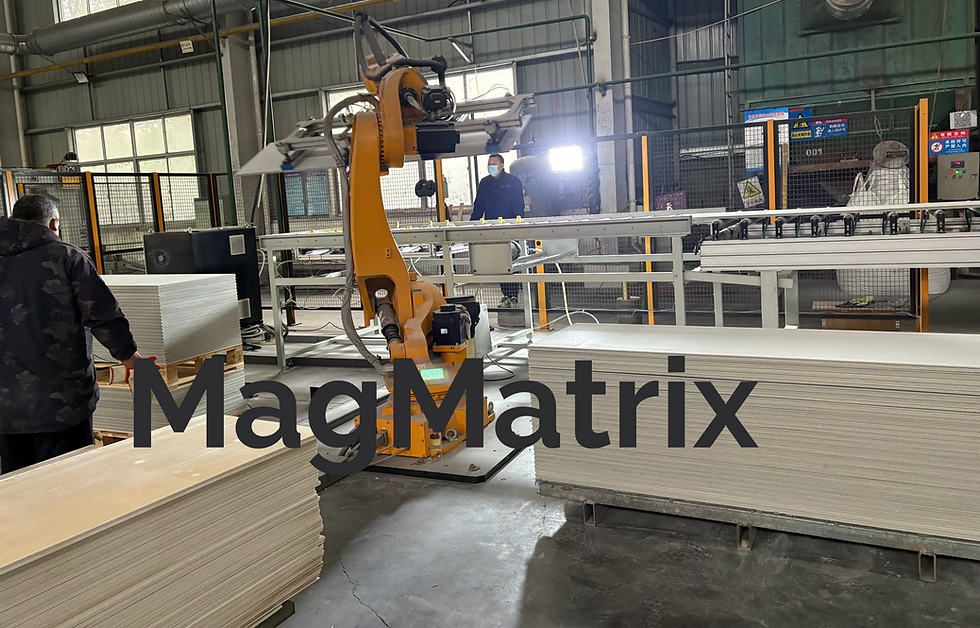
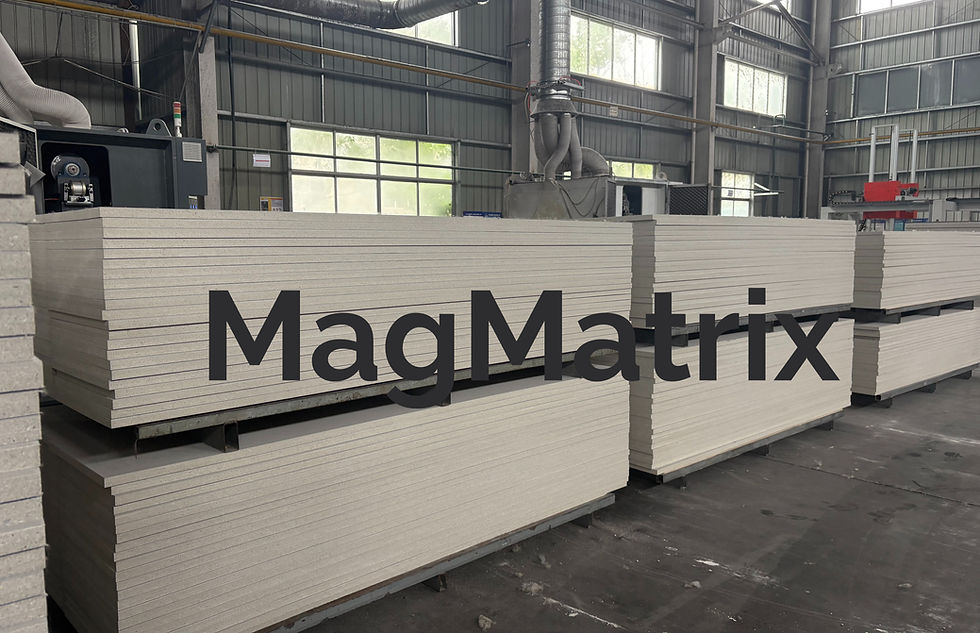
The MagMatrix Solution: At our Taixing production base, we enforce a strict, low-temperature, high-humidity initial curing cycle held precisely at a precisely and specific temerature rating with internal systems. This controlled hydration allows the crystals to interlock perfectly into a stable 5-1-7 Phase (5Mg (OH)2-MgSO4-7H2O). The result is an industry-low linear shrinkage rate of <0.05%, ensuring walls and subfloors remain permanently flat.
Problem 2: Compromised Modulus of Rupture (MOR) in Structural Framing
The Root Cause: When generic AI-written blogs praise sulfate boards as "100% waterproof and structural," they miss a vital distinction. Standard sulfate formulations often lack the density required to handle high dynamic live loads, leading to brittle snapping or low fastener pull-through resistance when drilled into heavy-duty steel or wood framing.
The MagMatrix Solution: To meet rigorous structural sheathing demands, we modified our core formula to incorporate 15–20% inorganic specifi fiber patented ingredients. Furthermore, we utilize a proprietary "Seed Induction" technique, introducing percentage patented high-performance micro-crystals into the slurry to act as crystalline catalysts. This engineering upgrade drives our flexural strength to approximately 30 MPa, providing unmatched structural capacity.
Understanding Traditional Magnesium Oxide Board Problems
When analyzing traditional Magnesium Oxide (MgO) board problems, the root cause almost always traces back to conventional Magnesium Oxychloride (MOC) chemistry. In high-humidity coastal or tropical environments, unreacted free chloride ions in these traditional boards absorb atmospheric moisture and migrate to the surface—a destructive phenomenon known as "sweating" or "crying" board syndrome. This chloride-rich moisture creates a highly corrosive environment that rapidly degrades standard galvanized fasteners and light-gauge steel framing, severely compromising the building's structural safety over time.
Furthermore, because many standard factories flash-dry these panels in high-heat kilns to accelerate production, the hurried process fractures the cement's molecular bonds. This causes substantial linear shrinkage and thermal movement once installed on-site, forcing joint compounds to crack and destroying the integrity of fire-wall assemblies. To eliminate these pervasive liabilities, advanced material science has shifted entirely away from chloride chemistry to stabilize the dense, permanent Basic Magnesium Sulfate Cement (BMSC) 5-1-7 crystalline phase.
Case Study: Engineering Resiliency with TechBoard® (ZS2 Technologies)
The ultimate validation of cement chemistry does not happen in a lab—it happens in the field. MagMatrix's advanced BMSC 5-1-7 formulation serves as the technical foundation for high-performance building envelopes across North America through our strategic partnership with ZS2 Technologies and their flagship TechBoard® line.
In the extreme, high-humidity, and freeze-thaw climates of Canada, traditional sheathing materials fall short. By deploying our advanced BMSC technology, TechBoard® delivers:
Absolute Chloride-Free Integrity: Total protection for light-gauge steel framing and fasteners against salt spray and coastal moisture.
Verified Fire Compliance: Seamless integration into severe fire-rated assemblies, backed by rigorous third-party certifications including ASTM E119 (1 & 2-Hour Fire Wall Tests) and ASTM E136 non-combustibility.
Carbon Sequestration Readiness: Supplying dense, stable mineral matrices that complement ZS2’s advanced formulations for lower-carbon, highly resilient structural insulated panels (SIPs).
The Bottom Line: Stop Buying Marketing. Start Sourcing Chemistry.
If you are currently evaluating suppliers and trying to mitigate potential magnesium sulfate board problems, look past generic "eco-friendly" compliance certificates. Ask for the factory's precise curing protocol, their molar ratios, and their verified North American project portfolio.
Don't let unstable crystal phases compromise your project’s safety or structural integrity.
Want to benchmark MagMatrix against your current supplier? [Request a Complimentary BMSC 517 Technical Sample Kit] or contact our engineering desk directly at David.zhao@magmatrixboards.com to review our full Intertek-audited ASTM data packages.

Comments