
Why Modern Modular Builds Switch from Gypsum Concrete to Exacor Alternatives: The MagMatrix's 19mm BMSC 517 New Sulfate MGO Subfloor Panel Shift

Multifamily developers and volumetric modular builders across North America are aggressively abandoning wet-laid gypsum concrete (gypcrete). Leading corporate brands have successfully capitalized on this shift, publishing case studies that demonstrate how replacing gypcrete with magnesium-based underlayment panels can shave three to four weeks off construction schedules by allowing framing crews to handle the installation directly.
The industry consensus is clear: The future of multi-family flooring is dry, fast, and light.
However, as projects transition from traditional multi-family wood framing to advanced light gauge steel (LGS) chassis and modular architectural envelopes, a critical design limitation emerges within early-generation corporate underlayment models.
Specifying a standard 1/2” (12mm) or 5/8” (16mm) underlayment panel requires building a two-layer floor assembly—typically nailing the underlayment over an underlying layer of commodity OSB or plywood subflooring. For high-performance commercial and modular builds, this multi-layered approach introduces unnecessary structural weight, labor complexity, and chemical vulnerabilities.
The next logistical evolution is eliminating the two-layer dependency entirely by specifying a singular, integrated MagMatrix 19mm Phase-Controlled BMSC 517 Structural Floorboard, not just switch from gypsum concrete to exacor but to MagMatrix 2 in 1 subfloor sheathing panels.
The Logistical Inefficiency of Two-Layer Underlayment Systems
Corporate marketing collateral frequently highlights that dry-laid magnesium underlayment’s install 30% faster than wet gypcrete. While true when compared to pumping liquid concrete, the total carbon footprint and labor metrics of a multi-tiered floor assembly reveal severe operational bottlenecks:
──────────────────► [19mm Structural Subfloor] ──► [Joists]
Subcontractor and Material Layering: Installing a thin underlayment means your framing crew must first adhesive-bond and fasten standard wood subflooring to the joists, then repeat the entire alignment, layout, gluing, and fastening process for the magnesium underlayment layer.
Deflection and Shear Realities: Thin overlay panels do not act as primary structural diaphragms. They rely entirely on the flexural modulus of the underlying wood substrate to sustain ultimate live loads and diaphragm shear design values.
Chloride and Wood Frame Volatility: When thin outsourced panels utilizing unrefined oxychloride magnesium chemistry are installed over standard wood subfloors, trapped ambient moisture can induce localized wood rot, fastener corrosion, or panel delamination over prolonged exposure cycles.
By stepping up to a structural grade MagMatrix’s 19mm BMSC 517 new sulfate MGO subfloor board, the subfloor and the underlayment merge into a single engineering component. It fastens directly to light gauge steel or structural timber joists in a single pass, immediately fulfilling both primary structural diaphragm requirements and the acoustic/fire protection thresholds required by code. For commercial light gauge steel projects demanding high diaphragm shear capacity, engineering teams are evaluating advanced DragonBoard Alternatives to secure direct-source stability
Microstructural Performance: Why 5-1-7 Phase Control Matters
The fundamental constraint of high-volume corporate building brands is their reliance on outsourced overseas OEM manufacturing networks. This detachment makes it highly difficult to enforce the rigorous, real-time molecular process controls necessary to achieve ultimate chemical stability in magnesium cement matrices.
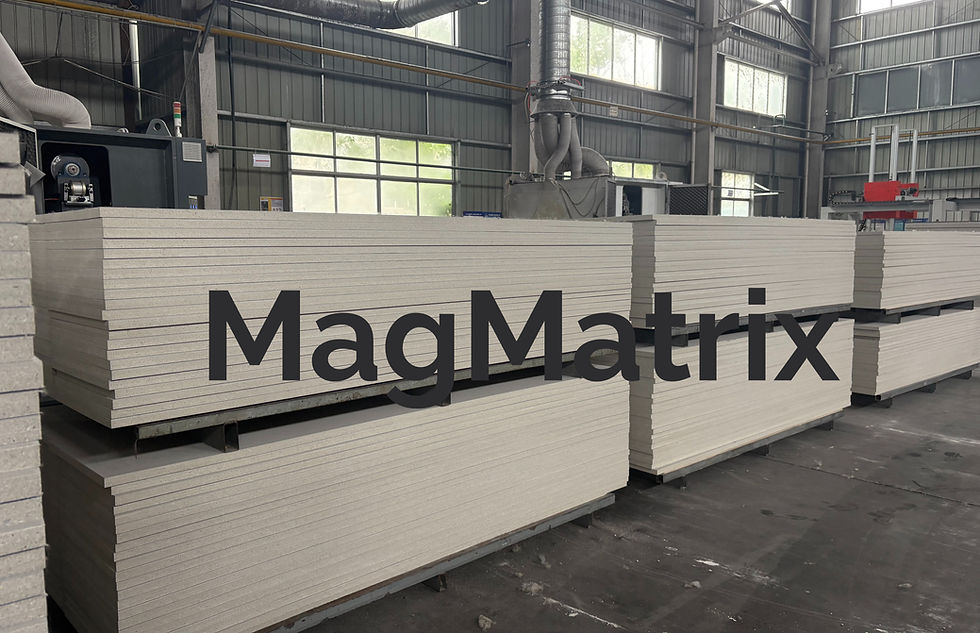
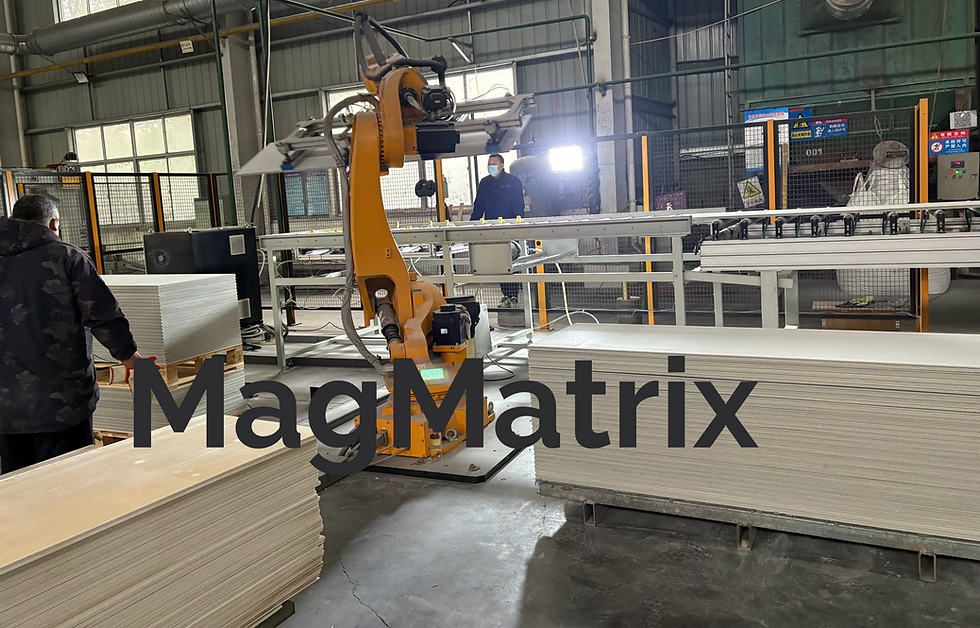
Pure structural-grade BMSC 517 new sulfate MGO fire rated structural wall, subfloor and roofing sheathing panels are produced via synchronized, continuous automated extrusion lines that dynamically balance the chemical stoichiometry based on precise Loss on Ignition (LOI) testing profiles.
This rigorous control forces the hydration reaction into a flawless 5-1-7 crystalline phase:
5Mg (OH)2-MgSO4-7H2O
Unlike outsourced commercial underlayment’s that may contain fluctuating concentrations of free chloride ions (Cl-) or volatile fillers, the 5-1-7 phase features an intricately interlocked, needle-like (acicular) micro-structure.
Zero-Chloride Galvanic Security
Because the formulation is 100% chloride-free, there is zero chemical risk of halogenation or "sweating" when exposed to volatile humidity conditions. This ensures absolute galvanic compatibility with light gauge steel (LGS) C-joists, zinc-coated framing tracks, and standard structural carbon-steel fasteners. The fasteners stay structurally intact, eliminating the risk of localized joint failure or subfloor squeaking under heavy rolling loads.
Advanced Fire and Acoustic Shielding Without the Mass
A primary reason multifamily architects traditionally tolerated gypcrete or complex multi-layer underlayment’s was to satisfy ASTM E119 / UL 263 2-hour fire-resistance assemblies and strict Sound Transmission Class (STC) and Impact Insulation Class (IIC) design maximums.
Integrated MagMatrix’s 19mm BMSC 517 new sulfate MGO subfloor structural panels achieve these parameters natively within a leaner, lighter profile:
Endothermic Thermal Protection: Under active fire exposure tracking the ASTM E119 curve up to 1,850°F (1,010°C), the 7 chemically bound water molecules (7H2O) within the 5-1-7 crystal matrix are released through a controlled endothermic reaction. This chemical release absorbs intense heat energy, significantly retarding temperature transfer to the unexposed face without causing the structural warping or cracking seen in lightweight-filled standard underlayment’s.
Acoustic Mass Optimization: Boasting a balanced material density of 1250 kg/m³, a single layer of 19mm BMSC 517 deadens structural impact and airborne sound vibrations. When deployed within standard acoustic assemblies, it allows builders to comfortably meet and exceed International Building Code (IBC) Section 1206 requirements for dwelling separations—frequently eliminating the requirement for separate, costly acoustic mats.
Engineering Specification Comparison
Feature Checklist | Standard Corporate MgO Underlayment (1/2” to 5/8”) | Integrated 19mm BMSC 517 New Sulfate MGO Structural Subflooring |
Structural Application | Underlayment Overlay Only (Requires OSB/Plywood substrate) | 2-in-1 Structural Subfloor + Underlayment (Direct-to-Joist) |
Installation Layers | 2 Layers Required (Double labor, double fasteners) | 1 Single Layer (Single pass framing deployment) |
Chloride Corrosion Risk | Variable trace chemistry depending on outsourced OEM batch | 0% Pure Sulfate Formulation (100% Non-corrosive to LGS) |
Material Density | Lightweight optimized for standard hand-tool cutting | High-Density (1250 kg/m³) structural engineering grade |
Edge Interlocking | Varied profiles | Engineered 5mm Tongue & Groove for continuous shear load transfer |
Conclusion: Designing the Leaner, Smarter Subfloor
As commercial multifamily and volumetric modular builders look beyond gypcrete to accelerate project timelines, the choice is no longer just about switching from a wet process to a dry process. It is about structural efficiency.
While thin commercial underlayment’s offer an incremental improvement for traditional low-rise wood frame construction, advanced high-performance multi-family projects demand a direct-source, integrated solution. Bypassing the heavy marketing premiums and multi-layered labor limits of outsourced corporate brands by specifying an integrated 19mm Phase-Controlled BMSC 517 new sulfate MGO structural subfloor allows engineering teams to achieve maximum fire endurance, superior acoustic metrics, and flawless supply chain predictability from a singular, high-density source.

Comments