
Exacor® Alternatives: Evaluating Phase-Controlled BMSC 517 vs. Standard MGO Panels for Multi-Family Subflooring

In the North American multi-family and light commercial construction sectors, alternative subflooring materials have moved from niche innovations to structural necessities. Driven by the critical need for a 2-hour fire-resistance rating (ASTM E119) and superior acoustic management (STC/IIC ratings) without the structural weight or drying delays of poured gypsum concrete over wood frame assemblies, corporate brands like Huber Engineered Woods have successfully commercialized magnesium-based subfloor panels under the Exacor® trademark.
While Exacor® has proven the viability of magnesium-based chemistry to the broader market, global supply chain volatility and advancing material science are prompting structural engineers, modular builders, and developers to re-evaluate their specifications. High-performance projects increasingly demand a direct, transparent technological baseline.
For projects transitioning to high-density volumetric modular designs or light gauge steel (LGS) framing, understanding the microstructural differences between outsourced commercial brands and direct-source Phase-Controlled Basic Magnesium Sulfate Cement (BMSC 517) platforms is critical.

The Supply Chain Reality: OEM Brand vs. Source Manufacturer
Evaluating subflooring options requires analyzing both chemical makeup and production origins. Huber Engineered Woods is fundamentally an engineered wood specialist, renowned for OSB platforms like AdvanTech® and ZIP System®. The Exacor® product line represents a strategic diversification executed via an OEM (Original Equipment Manufacturer) model, outsourcing panel production to overseas manufacturing assets.
For large-scale, multi-family construction, an outsourced supply chain introduces inherent project risks:
Rigid Customization Limitations: Adapting density, thickness, or edge profiles (such as specific tongue-and-groove configurations) to meet unique dynamic shear loads is highly restricted under cross-border OEM agreements.
Macro Supply Disruption: Extended logistics chains leave projects vulnerable to transit delays, localized factory allocations, and inventory shortages.
Quality Control Gaps: The critical challenge of magnesium cement production is real-time chemical adaptation. An outsourced corporate brand cannot easily dynamically alter factory formulations based on seasonal fluctuations in raw materials.
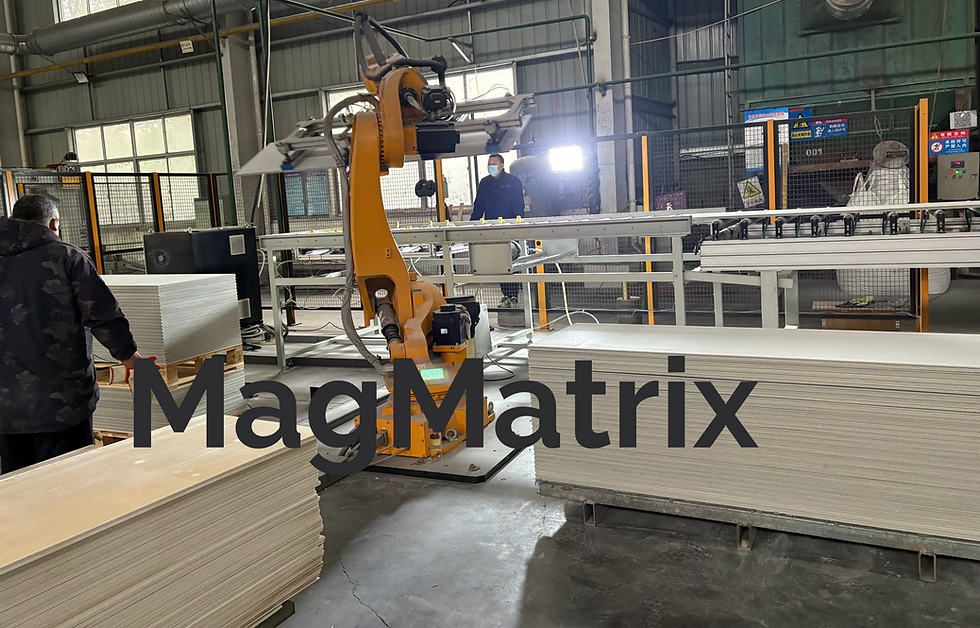
Direct source manufacturing platforms, utilizing centralized, automated continuous extrusion lines, eliminate the intermediary layer. This direct engineering control guarantees both structural predictability and agile scalability for high-volume contract commitments.
Microstructural Analysis: Traditional Magnesium Chemistry vs. BMSC 517
To understand why advanced building envelopes are specifying MagMatrix’s BMSC 517 new sulfate MGO board formulation and technology alternatives over traditional magnesium formulations, one must look at the microcrystalline structure of the cement matrix.
[Traditional Oxychloride Matrix] ──► Free Chloride Ions ──► Leaching/Sweating ──►
The Chloride Liability
First-generation magnesium subfloors utilize a magnesium oxychloride cement matrix. While highly durable in controlled environments, oxychloride matrices contain free chloride ions (Cl-). Under high relative humidity or coastal exposure, these ions absorb atmospheric moisture, resulting in halogenation or "sweating." When this chloride-laden moisture contacts light gauge steel framing, zinc-coated studs, or structural carbon-steel fasteners, it triggers rapid, severe galvanic corrosion.
The Phase-Controlled Sulfate Solution
Advanced alternatives utilize a 100% chloride-free magnesium sulfate matrix engineered precisely to form the 5-1-7 crystalline phase:
5Mg (OH)2-MgSO4-7H2O
When synthesized under automated, climate-controlled industrial conditions—utilizing an initial curing phase at approximately specific temperature followed by forced cooling measures actions after the exothermic peak—the hydration reaction creates a highly dense, interlocking network of acicular (needle-like) crystals. This interlocking matrix locks the components in place, delivering a hydroscopically stable panel that will not leach, sweat, or degrade nearby structural metal fasteners or LGS framing components.
Performance Comparison Matrix
The table below outlines the performance characteristics of standard MGO subflooring options compared to engineered, high-density MagMatrix BMSC 517 new sulfate MGO BOARD structural panels for Exacor Alternatives,
Engineering Parameter | Commercial OEM MGO Panels (e.g., Exacor®) | Engineered BMSC 517 Structural Floorboards (MagMatrix) |
Chemical Basis | Magnesium Oxide / Silicate Blend (Oxychloride/Sulfate variations) | Pure Basic Magnesium Sulfate Cement (5-1-7 Phase) |
Chloride Content | Variable; potential traces depending on outsourced source batch | 0% Zero Chloride (100% Non-corrosive) |
Density & Matrix | Standard density optimized for light wood-frame multi-family | High-Density (1250 kg/m³) interlocked acicular lattice |
Curing Protocol | Standard ambient or tunnel kiln curing | Phase-controlled: specific temperature setting + forced exothermic management |
Fastener Compatibility | Restricted to brand-specified coated fasteners | Universal compatibility with standard structural fasteners & LGS framing |
Edge Geometry | Standard T&G | Engineered 5mm Tongue & Groove for optimized shear transfer |
Thermal Performance under ASTM E119 2-Hour Exposure
Both high-performance platforms target compliance with ASTM E119 / UL 263 fire-resistance directories for floor-ceiling assemblies. However, their physical behavior under active thermal load differs during the 120-minute furnace curve.
When subjected to the intense heat of an ASTM E119 test—where furnace temperatures surpass 1,850°F (1,010°C) at the 2-hour mark—the endurance of the subfloor depends entirely on the stability of its chemical bonds.
Standard OEM panels often incorporate lightweight fillers to optimize handling weights for residential framing crews. Under extreme heat, these fillers can accelerate micro-fissure propagation across the panel span.
In contrast, an engineered 19mm BMSC 517 structural floorboard relies on its pure, dense 5-1-7 crystal matrix. The 7 chemically bound water molecules ($7H_2O$) within the crystal lattice are released endothermically under fire exposure, actively consuming thermal energy and delaying temperature transmission to the unexposed face.
Simultaneously, the absence of volatile fillers prevents structural warping, ensuring that the assembly maintains its complete load-bearing diaphragm capacity without buckling or letting hot gases breach the joints.
Industrial Process Control: The Mitigation of Micro-Cracking
The fundamental difference between choosing a commercial market brand and partnering with a direct-source technical manufacturer lies in the rigor of the production chemistry. The reaction between magnesium oxide and magnesium sulfate is highly exothermic. If the heat of hydration is left unmanaged, thermal spikes can dehydrate the core, causing micro-fractures that compromise the panel's long-term flexural modulus.
Direct-source BMSC 517 production utilizes sophisticated, automated extrusion lines that continuously monitor raw materials through rigorous Loss on Ignition (LOI) parameters. Adjusting the chemical stoichiometry dynamically to hit specific targets neutralizes climatic variables.
Combined with a strict secondary curing phase at specific temperature for 6–8 days, this ensures that every batch delivered to an international job site exhibits identical structural characteristics.
Conclusion: Engineering the Optimal Specification
For standard multi-family wood-frame builds with established regional distributors, commercial brand solutions like Exacor® remain a viable, code-compliant choice.
When project teams decide to switch from gypsum concrete to Exacor platforms, evaluating structural frame compatibility is essential
However, when a project demands maximum structural capacity, complete elimination of corrosion risks in light gauge steel modular assemblies, and direct engineering accountability, Phase-Controlled BMSC 517 technology offers the logical evolutionary path. By bypassing the premium costs of outsourced brand marketing and sourcing directly from an automated chemical manufacturer, developers and structural engineers gain superior material performance, robust supply chain security, and predictable structural performance.
Comments