
DragonBoard® Alternatives: Choosing Direct-Source BMSC 517 for LGS Modular Chassis

In the North American commercial construction and off-site volumetric modular sectors, the transition to Light Gauge Steel (LGS) framing has redefined structural engineering limits. To maximize the weight-reduction benefits of LGS assemblies while meeting stringent multi-family and commercial codes, eliminating wet gypsum concrete (gypcrete) over floors is a primary operational objective.
For years, corporate distribution brands like DragonBoard® USA—backed by heavy steel-framing networks like Super Stud Building Products—have dominated specifications by offering 3/4” (19mm) magnesium-based subfloor panels.
By tying their subfloor into an integrated LGS shell package (studs, tracks, and joists) and securing crucial structural listings like UL Design G575 for 2-hour fire-resistance assemblies, DragonBoard® successfully commercialized dry-laid, sulfate-based subflooring.
However, as the volumetric modular industry matures, structural engineers and modular design directors are encountering the limits of outsourced corporate supply chains.
For advanced LGS chassis designs demanding precise diaphragm shear capacities, dynamic customization, and absolute microcrystalline stability, relying on an intermediary corporate distributor introduces unnecessary cost and quality control gaps. The industrial alternative is transitioning to direct-source, MagMatrix's Phase-Controlled Basic Magnesium Sulfate Cement (BMSC 517) platforms.
The Structural Vulnerability of Intermediary OEM Sourcing
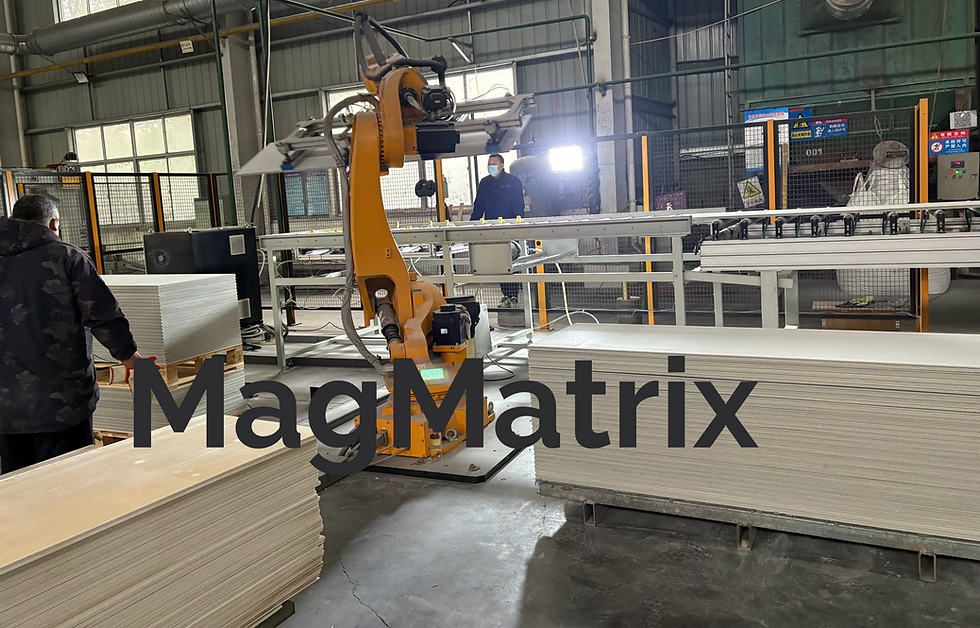
While DragonBoard® excels at high-volume domestic distribution within established structural steel packages, its underlying business model relies on overseas OEM (Original Equipment Manufacturer) contract fabrication. In high-stakes B2B modular manufacturing, this detachment from the active factory floor creates inherent risks:
Formulaic Inflexibility: Volumetric modular design varies significantly by project. A custom chassis may require a specific structural density variation, non-standard panel thickness, or a specialized 5mm Tongue & Groove (T&G) edge routing to optimize inter-module shear transfer. Corporate brands operating under rigid OEM agreements cannot easily modify active factory runs for tailored project volumes.
Loss of Real-Time Process Accountability: The synthesis of magnesium sulfate cement is a highly sensitive, highly exothermic chemical reaction. An outsourced brand cannot implement or monitor real-time chemical adaptations at the mixing head. When structural integrity is critical, relying on a broker means inheriting unverified chemical variances between manufacturing batches.
Chemical Matrix: Standard Sulfate MgO vs. Phase-Controlled BMSC 517
Both high-performance platforms leverage magnesium sulfate (MgSO4) chemistry rather than traditional magnesium oxychloride (MgCl2) to eliminate free chloride ions (Cl-), completely preventing the galvanic corrosion of LGS C-joists and carbon-steel fasteners.
However, the divergence lies in the precision of the microcrystalline formation. Standard commercial sulfate panels often exhibit erratic crystal phase distribution due to unmanaged ambient curing temperatures. Direct-source MagMatrix's BMSC 517 new sulfate MGO fire rated structural floorboards utilize fully automated continuous extrusion lines governed by rigorous Loss on Ignition (LOI) raw material matching.
By dynamically tuning the chemical stoichiometry to a precise target ratio, the matrix is forced to hydrate entirely into the stable 5-1-7 crystalline phase:
5Mg (OH)2-MgSO4-7H2O
[Standard Sulfate M
This specific phase forms a highly dense, interlocking needle-like (acicular) microcrystalline matrix. Unlike standard commercial formulas that can develop micro-fissures over long-term heavy commercial rolling loads, the 5-1-7 lattice delivers an exceptional flexural modulus and superior long-term fatigue resistance under structural cyclic loading.
Structural Diaphragm and Shear Performance (ASTM E455)
In multi-story LGS construction, the subfloor is not merely a walking surface; it acts as a primary horizontal structural diaphragm. It must resist and transfer lateral wind, and seismic shear loads to the vertical shear walls.
DragonBoard® heavily advertises its structural data under ASTM E455. Direct-source high-density (1250 kg/m³) MagMatrix's BMSC 517 new sulfate MGO fire rated structural subfloor sheathing platforms meet and exceed these exact baseline metrics while offering superior screw-pullout resistance.
When self-drilling, self-tapping structural fasteners are driven into a pure MagMatrix 19mm BMSC 517 new sulfate MGO board matrix which is direct manufacturing plant and Dragonboard alternatives, the dense needle-like crystal structure grips the thread tightly without the edge-crumbling or blowouts common in lightweight-filled or unrefined commercial-grade panels.
Furthermore, an engineered 5mm T&G profile guarantees continuous, uninterrupted shear transfer across panel joints, eliminating the need for blocking underneath the seams and significantly reducing steel framing dead weight.
Thermal Kinetics: Decoding the 2-Hour Fire Wall (UL G575 & ASTM E119)
Passing a 2-hour ASTM E119 furnace test requires managing extreme thermal energy over 120 minutes, where temperatures peak at 1,850°F (1,010°C).
Standard commercial panels often rely on adding lightweight perlite fillers or unrefined silicate blends to minimize shipping weights. Under rapid thermal expansion during an ASTM E119 test, these disparate materials expand at different rates, potentially propagating micro-fissures that allow hot gases to breach the assembly joints.
A pure MagMatrix's 19mm BMSC 517 new sulfate MGO fire rated and structural subfloor uses a completely different thermal kinetic mechanism: Endothermic Crystal Dehydration.
The 7 chemically bound water molecules (7H2O) locked within the 5-1-7 crystal lattice act as a built-in fire suppression system. When heat hits the panel, these water molecules undergo a controlled endothermic release, turning to steam and absorbing massive amounts of thermal energy. This chemical process keeps the unexposed side of the floor assembly well below code-allowed temperature rises, preserving the structural capacity of the underlying LGS joists without bowing or warping.
Technical Performance Matrix
Engineering Parameter | Commercial Corporate Panel (e.g., DragonBoard® 3/4") | Direct-Source MagMatrix's 19mm Perseverance BMSC 517 New Sulfate MGO Subfloor Board |
Supply Chain Origin | Outsourced Overseas OEM / Intermediary Distributor | Direct-to-Source Automated Chemical Manufacturer |
Crystalline Structure | Mixed Sulfate Matrix / Variable Curing | 100% Phase-Controlled 5-1-7 Acicular Lattice |
Material Density | Standard commercial grade | High-Density (1250 kg/m³) |
Process Control | Batch-testing via third-party providers | Real-time LOI adjustment + post-exothermic cooling |
LGS Compatibility | 0% Chloride (Sulfate-based) | 0% Chloride (Pure BMSC 517 Formulation) |
Custom Engineering | Highly limited; dependent on rigid broker catalog | Fully customizable (Thickness, density, edge profile) |
Edge Geometry | Standard T&G | Precision 5mm Tongue & Groove for optimized shear transfer |
Conclusion: Eliminating the Broker Premium
For standard low-rise commercial projects utilizing pre-established structural packages from domestic steel distributors, commercial brand overlays like DragonBoard® remain a functional specification.
However, for advanced volumetric modular manufacturers, off-site prefabricators, and structural engineers designing next-generation LGS chassis, the corporate middleman represents a bottleneck in both supply chain flexibility and technical precision.
Transitioning to a direct-source, phase-controlled MagMatrix's 19mm BMSC 517 new sulfate MGO subfloor sheathing panel allows engineering teams to eliminate premium brand marketing markups while securing total control over chemistry, product customization, and delivery timelines. By dealing directly with the automated manufacturing source, modern modular projects achieve unmatched structural predictability, uncompromised fire safety, and a highly optimized bottom line.

Sounds good. Time Duration Calculator