
Next-Gen Fire Rated Structural Sheathing Panel Materials: Why Phase-Controlled BMSC 517 New Sulfate MGO Board Is Evolving Beyond Traditional MGO in High Performance Buildings

As extreme weather events and shifting global climates push architectural demands to new limits, structural engineers and modular builders are increasingly turning to magnesium-based chemistry for resilient envelopes. High-performance sheathing must deliver uncompromised fire protection, mold resistance, and carbon-negative footprints.
While traditional Magnesium Oxide (MGO) products have laid the groundwork for this material revolution, the industry is transitioning toward a more advanced chemical evolution: Phase-Controlled Basic Magnesium Sulfate Cement (BMSC 517) technology.
To design truly resilient infrastructure, building professionals must understand why standard MGO solutions are being superseded by BMSC 517 platforms.
The Historical Liability of First-Generation MGO
Traditional MGO boards rely on a magnesium oxychloride matrix. While naturally non-combustible and durable under ideal conditions, the presence of free chloride ions (Cl-) introduces structural risks when exposed to changing, highly humid climates:
Halogenation ("Sweating"): In coastal or high-humidity regions, chloride-based boards absorb atmospheric moisture, leaching salty droplets onto the board surface.
Fastener and Structural Corrosion: This leached moisture tracks along the substrate, causing rapid, severe galvanic corrosion to light gauge steel (LGS) framing, zinc-coated studs, and standard carbon-steel fasteners.
For modern off-site modular manufacturing and mid-rise structural framing, these liabilities are unacceptable.
[Traditional MGO Matrix] ──► Free Chloride Ions ──► Atmospheric Moisture Arption ──► Structural Steel Corrosion
The BMSC 517 Breakthrough: Engineering the 5-1-7 Crystalline Phase
Advanced BMSC 517 new sulfate MgO Board technologies completely replace magnesium chloride with a specialized magnesium sulfate matrix, eliminating the source of structural corrosion.
The true engineering achievement lies in the precision crystallization of the 5-1-7 phase:
5Mg (OH)2-MgSO4-7H2O. which is the keypoint to achieve the sulfate MGO board ASTM E119 assemblies.

When synthesized under strict automated factory conditions—incorporating a precise specific temperature initial set and managed exothermic fan-cooling—the chemical reaction forms a dense, interlocking network of acicular (needle-like) crystals. This crystalline microstructure completely locks the matrix, delivering superior performance metrics across four critical pillars:
1. Zero Corrosion in Low-Carbon LGS Framing
Because BMSC 517 boards are completely chloride-free, they present zero corrosion risk to light gauge steel systems and structural fasteners. Engineers can specify these panels for exterior sheathing and structural sub-flooring without fearing connection failures or structural degradation over the building's lifespan.
2. High Shear and Flexural Capacity for Volumetric Modular Assembly
Modern multi-story modular construction demands sheathing that acts as a structural diaphragm. The interlocked 5-1-7 crystalline architecture yields exceptional modulus of rupture (MOR) and shear resistance. This makes engineered 19mm structural floorboards highly capable of sustaining heavy design loads and resisting dynamic stresses during module transport and crane setting and is most ideal for LGS framing sheathing applications and also for the subfloor sheathing panel with 19mm structural floorboard.
3. Ultimate Climate Stability and Dimensional Predictability
Extreme climate shifts bring severe wet-dry and freeze-thaw cycles. Thanks to the highly stable, non-hydroscopic 5-1-7 lattice, BMSC 517 panels exhibit a virtually non-existent linear expansion coefficient. They do not warp, buckle, or pull away from fasteners under intense humidity shifts, maintaining air barrier integrity and preventing joint-compound cracking.
4. Certified Fire Safety and Non-Combustibility
BMSC 517 technology maintains the superior fire-performance properties inherent to magnesium cement. The material is naturally non-combustible, contributing zero fuel and zero smoke to assemblies, making it an ideal core material for strict ASTM E119 2-hour fire-rated wall and floor assemblies and ASTM E136 compliance.
Industrial Precision vs. Empirical Blending
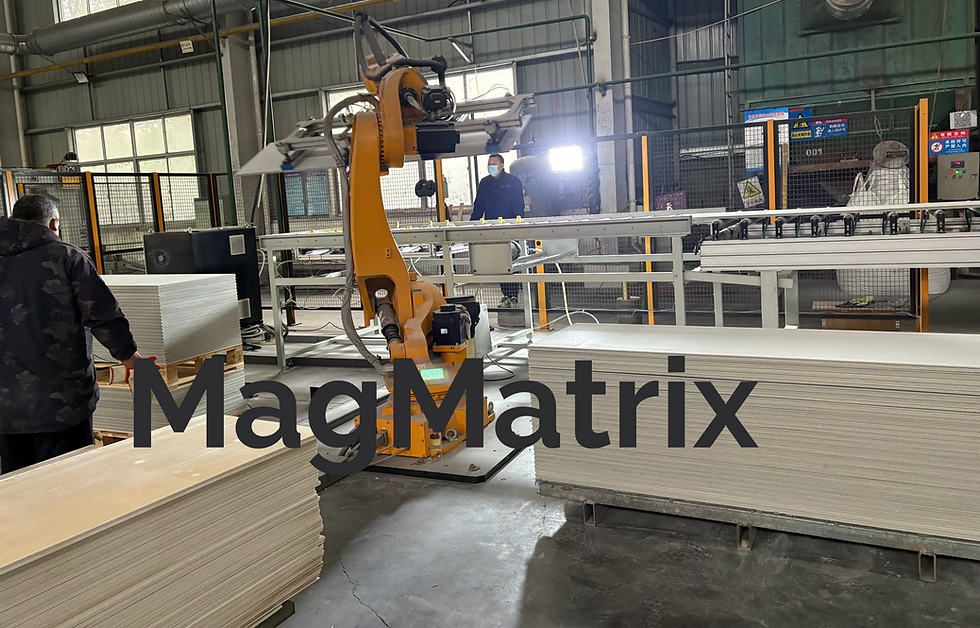
Achieving a stable 5-1-7 phase requires a level of manufacturing sophistication that goes beyond traditional, manual board pouring. The hydration reaction of magnesium sulfate is highly exothermic. Without real-time thermal dissipation and continuous automated dosing, unregulated heat spikes dehydrate the developing crystal structure, creating a brittle, low-grade panel.
True next-generation BMSC 517 non-corrosive MGO board manufacturing relies on fully automated, continuous extrusion lines and rigorous Loss on Ignition (LOI) testing of raw magnesium oxide components. This guarantees that whether the panel is produced in the winter or summer, the chemical stoichiometry and phase equilibrium remain identical, yielding predictable physical performance in the field.
The New Standard for High-Performance Building Envelopes
As global building codes tighten and carbon performance becomes mandatory, building with first-generation, chloride-based materials introduces unnecessary structural liabilities.
For projects requiring resilient, long-lasting, and high-load capacities, Phase-Controlled BMSC 517 technology delivers the ultimate combination of fire protection, structural strength, and chemical durability. It is no longer just an alternative sheathing option; it is the new benchmark for high-performance, climate-resilient architecture. Our this BMSC 517 new sulfate MGO board technology would be the keypoint in the high performance buildings with climate-resilient architecture.
Comments