
Looking for Sulfycor MgO Boards? Here’s What B2B Buyers Need to Know About True BMSC 5-1-7 Technology

When sourcing Chloride-Free MgO Boards or Magnesium Oxide Sulfate Boards, commercial developers and structural engineers frequently come across manufacturers like Sulfycor. Promoted as a solution to the notorious "crying board" and fastener corrosion issues of traditional MOC (Magnesium Oxychloride) boards, sulfate-based panels have rightfully become the industry standard for coastal and high-humidity construction.
However, for enterprise-level buyers looking for verified structural load-bearing capacity and strict compliance with international fire codes (ASTM/AS/NZS), not all sulfate boards are created equal.
If you are currently evaluating Sulfycor or similar products for your next project, here is why a deeper look into the underlying material science—specifically MagMatrix’s BMSC 5-1-7 Technology—might completely redefine your product specification.

1. Beyond "Chloride-Free": The Matrix of the 5-1-7 Crystal Phase
Most basic sulfate board manufacturers successfully eliminate chloride ions to prevent metal corrosion, which is a great baseline. But removing chloride is only half the battle. The true indicator of a board’s lifespan is its crystalline phase stability.
While standard manufacturing methods can result in erratic crystal growth, MagMatrix utilizes an advanced "Seed Induction" Technology. By introducing 30% high-purity micro-crystals into the raw slurry, we force the formation of a perfect 5-1-7 Phase (5Mg(OH)2-MgSO4 -7H2O).
The Structural Impact: This engineered crystal lattice boosts the Modulus of Rupture (MOR) and guarantees that our 16mm and 19mm floorboards provide unmatched fastener pull-through resistance under high dynamic loads—capabilities that go far beyond standard decorative or partition wall applications.
2. The Curing Pitfall: Flash-Drying vs. Precision Hydration
When manufacturers scale up production (boasting tens of thousands of square meters per day), they often accelerate the curing process using high-heat industrial kilns.
Sulfoxide cement reactions are highly exothermic (they release heat). Forcing them to dry too fast fractures the molecular bonds, leading to micro-cracking and a high linear shrinkage rate once the boards hit the job site.
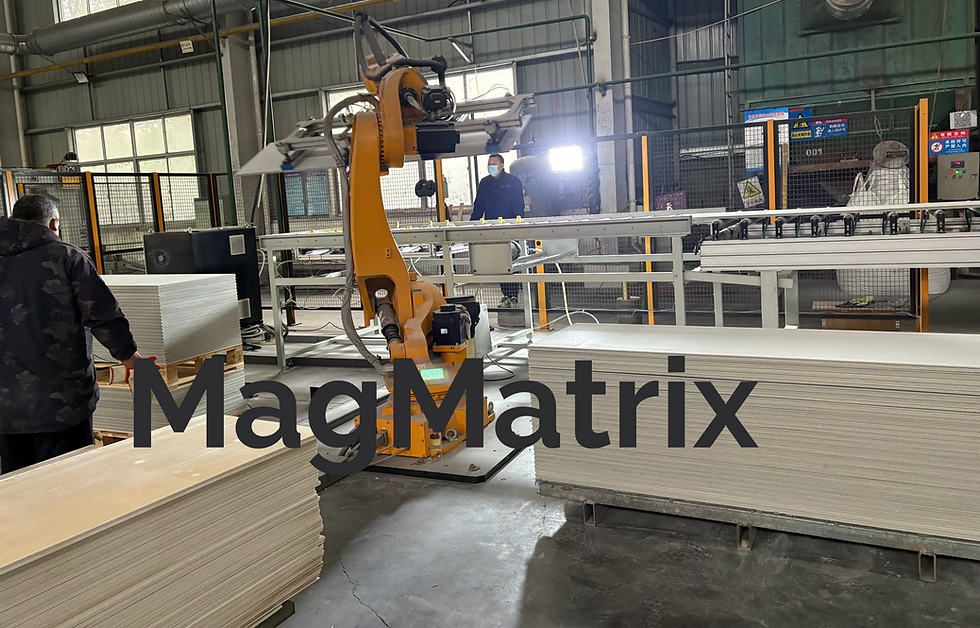
The MagMatrix Difference: At our automated production base, we employ a specific temperature, specific-humidity initial curing chamber. This slow, controlled hydration ensures the board reaches full chemical maturity before diamond-cutting. The result? An industry-low linear shrinkage rate of <0.05%, completely preventing joint cracking in seamless partition wall assemblies.
3. Comparing the Credentials: Testing for the Global Market
For B2B procurement in North America, Australia, and Europe, a factory’s internal QC data is a start, but independent, accredited testing is what legal compliance stands on.
Before committing to a bulk container order, compare the verified testing portfolios:
Performance Metric | Standard Sulfate Board Industry Average | MagMatrix Perseverance Series |
Chloride Content | Near Zero | Absolute Zero (100% Core Certified) |
Fire-Rated Assemblies | A1 Non-combustible | ASTM E119 Verified (1 & 2-Hour Fire Wall Assembly) |
Structural Testing | Basic Impact Resistance | ASTM E136 & Full Intertek Audited Structural Loads |
Global Compliance | Standard ISO Protocols | Active ICC-ESR Pipeline / AS 1530.1 Approved |
4. Direct Factory Tailoring for High-Stakes Engineering
Many brands operate as high-volume suppliers optimized for standard interior wallboards or 2mm-12mm decorative backings. But when your blueprint demands 19mm heavy-duty mezzanine subflooring, structural external sheathing, or integration into SIPs (Structural Insulated Panels), you need an engineering partner, not just a supplier.
MagMatrix works directly with world-class green-tech innovators to co-develop custom-formulated BMSC panels reinforced with Aluminosilicate fibers and Wollastonite for extreme architectural demands.
Conclusion: Make an Informed Choice for Your Project
While brands like Sulfycor offer a valid alternative to outdated chloride-rich MGO panels, high-stakes commercial projects require materials that eliminate the risks of shrinkage, warping, and structural fatigue under stress.
Before signing your next procurement contract, ensure your supplier can provide full TG/DTG thermal analysis and Intertek-backed ASTM reports.
Want to benchmark MagMatrix against your current MgO supplier? [Request a Complimentary BMSC 517 Sample Kit] or consult directly with our technical engineering team to review our official laboratory test data.
Comments