
Engineering the 5-1-7 Phase: The Chemical Kinetics and Thermal Management of Next-Gen BMSC MGO Boards

In high-performance structural sheathing, the transition from traditional Magnesium Oxychloride (MGO) to Basic Magnesium Sulfate Cement (BMSC) is a major shift in material science. For engineering professionals, the value of BMSC isn't just that it is "chloride-free"—it lies in the precise thermodynamic and microstructural control of the 5-1-7 crystalline phase.
While traditional MGO is prone to hydroscopic degradation and halogenation (sweat-out) due to free chloride ions, stabilized BMSC relies on a dense, non-hydroscopic matrix. Achieving this requires strict control over the exothermic reaction pathway and crystal morphology.

1. Reaction Mechanics and Phase Equilibrium
The performance of advanced sulfate MGO boards depends on forming the needle-like basic magnesium sulfate crystal: 5Mg (OH)2-MgSO4-H2O (the 5-1-7 phase).
Unlike the 3-1-8 or 1-1-5 phases, which can be structurally unstable or form poorly under suboptimal conditions, the 5-1-7 phase provides superior mechanical tensile strength and dimensional stability. The fundamental stoichiometric reaction follows this pathway:
5MgO + MgSO4 + 12H2O to Mg (OH)2-MgSO4-7H2O
To ensure complete conversion and prevent unreacted compounds, chemical engineers must maintain a strict molar ratio of active MgO to MgSO4 (typically between 9.0 and 10.0) and a tightly controlled H2O-to-MgSO4 ratio.
Excess MgO leads to unreacted brucite (Mg (OH)2), causing localized volumetric expansion and micro-cracking over time.
Excess Sulfate leaves free acid or unreacted salts, increasing water absorption and weakening the structural matrix.
2. Managing the Exothermic Peak and Curing Dynamics
The formation of the 5-1-7 phase is highly exothermic. The hydration reaction releases significant thermal energy, and managing this heat curve determines the board's ultimate mechanical performance.
Temperature
(°C└───┴────────────────────────────────► Time
If the internal core temperature spikes too quickly, the rapid crystallization forces a chaotic, poorly oriented crystal lattice, resulting in macroscopic brittleness.
The Precision Curing Protocol
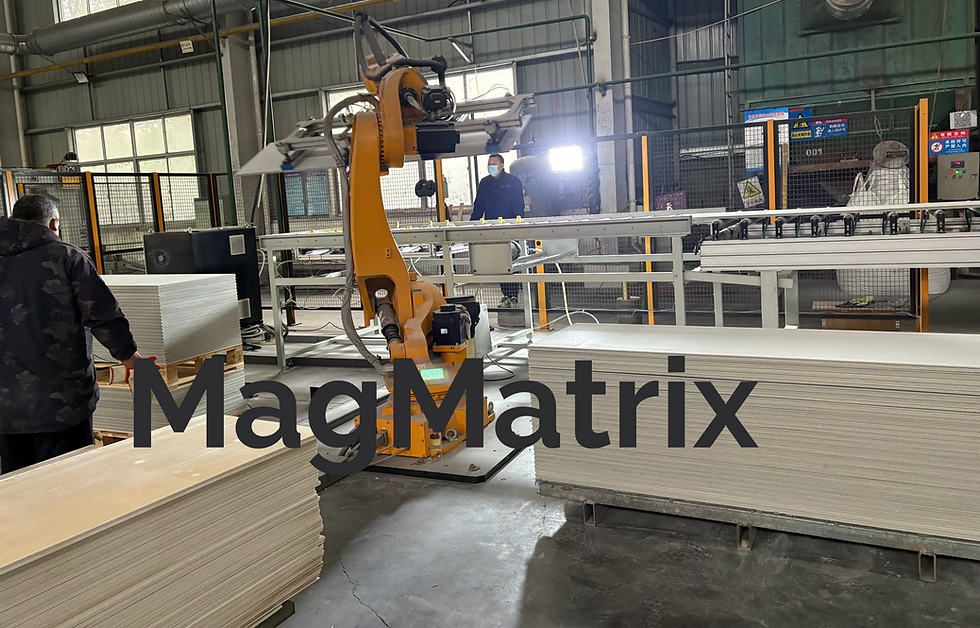
Advanced automated manufacturing facilities utilize a multi-stage thermal management process to ensure uniform crystallization:
Initial Hydration & Gel Formation: The slurry is maintained at a controlled ambient temperature specific to initiate uniform gelation without causing premature thermal stresses.
Exothermic Peak Regulation: As the reaction accelerates toward its thermal peak, targeted fan-cooling systems dissipate core heat. This prevents localized overheating, which would otherwise dehydrate the developing 7H2O crystalline structure.
Secondary Curing Maturation: Following the initial set, the boards undergo a rigorous 8-day secondary curing period. This extended phase allows for steady, long-term matrix maturation, ensuring complete consumption of free components and the structural stabilization of the 5-1-7 phase.
3. Microstructural Architecture: Scanning Electron Microscopy (SEM) Insights
Under Scanning Electron Microscopy (SEM) and X-ray Diffraction (XRD) analysis, the structural superiority of a properly cured BMSC 517 board becomes highly visible.
|||||||||||||||||
Poor Thermal Management: Results in an amorphous or flaky microstructure with high porosity. This open network allows micro-fissures to propagate easily under structural loading.
Precision Thermal Management: Generates a dense, highly interlocked network of acicular (needle-like) crystals. These elongated 5-1-7 crystals interlace tightly around fiberglass reinforcing meshes and functional fillers, acting like microscopic rebar.
This dense microstructure blocks water vapor transport pathways, dropping water absorption rates far below traditional MGO standards and eliminating the risk of delamination under cyclical wet-dry testing.
4. Structural Engineering Implications
For structural engineers designing modular buildings, light gauge steel (LGS) framing, or high-performance wall assemblies, this chemistry translates directly into reliable physical properties:
Zero Steel Degradation: The absolute elimination of chloride ions (Cl-) ensures that the board remains entirely non-corrosive to zinc-coated LGS studs and carbon-steel fasteners, preventing structural fastening failures.
Advanced Dimensional Stability: With a virtually non-existent linear expansion coefficient under fluctuating humidity, BMSC 517 boards minimize structural movement, preventing joint cracking and finish failures in exterior sheathing.
High Shear and Flexural Capacity: The interlocking 5-1-7 crystalline network yields exceptional modulus of rupture (MOR) values, making 19mm variants highly suited for heavy-duty structural floorboards under strict international certification paths like ICC-ESR and ASTM E119 2-hour fire-rated assemblies.
Engineering the Future of Infrastructure
Transitioning from empirical, traditional mixing to high-precision, phase-controlled BMSC 517 chemistry represents a major upgrade for magnesium cement technology. By mastering the thermodynamics of the exothermic peak and stabilizing the 5-1-7 crystalline phase, modern manufacturing delivers a reliable, high-load structural material that meets global building codes.
Comments