
Magnesium Sulfate Board: What Builders Need to Know in 2026

Magnesium sulfate board provides exceptional fire resistance and holds an A1 non-combustible classification under the EN13501-1 standard. This innovative building material can withstand high temperatures for 60 to 90 minutes. The extended resistance time helps people evacuate safely during emergencies and reduces structural damage.
On top of that, these boards show superior moisture resistance and stay corrosion-free. These properties make them perfect for high-humidity areas and coastal regions. MgSO₄ boards perform better than magnesium oxide boards in wet conditions and maintain their shape well. The absence of chloride makes them less likely to absorb moisture or cause metal corrosion.
The boards are eco-friendly and use natural materials that align with sustainability goals. Their strength surpasses traditional building materials, which ensures they last longer in projects of all sizes. These boards are a great way to get health and safety benefits for homeowners and contractors, unlike standard options such as gypsum-based panels and drywall.
This detailed guide will show builders everything they need to know about magnesium sulfate boards in 2026. We'll cover their composition, manufacturing process, performance features, and real-world applications in modern construction.

Material Composition and How It Differs from MgO Boards
The main difference between magnesium sulfate board and traditional magnesium oxide boards comes from their chemical makeup and binding agents. These differences explain why they perform differently in construction.
Magnesium sulfate Board vs magnesium chloride Board
Magnesium sulfate boards employ magnesium sulfate (MgSO₄) as the binding agent, while traditional MgO boards use magnesium chloride (MgCl₂). This change marks a big step forward in board technology. A typical MgSO₄ board has 27-29% magnesium sulfate that works with 56-58% magnesium oxide as the core material.
Magnesium sulfate's biggest advantage is its resistance to moisture. Magnesium chloride easily absorbs moisture from its surroundings. Traditional MgCl₂-based boards often develop "weeping" - where moisture leaks from the board as time passes. MgSO₄ boards solve this issue by preventing moisture from getting back into the board.
MgSO₄ boards contain just 1% dissolvable chloride, while MgCl₂ boards have about 5%. This lower amount almost eliminates any risk of corrosion to metal fasteners and framing materials.
Role of perlite, wood fiber, and fiberglass mesh
Both board types share similar supporting materials in these amounts:
· Perlite: Makes up 3-4% of both types, boosting insulation and cutting weight
· Wood fiber/cellulose: Takes up 5-6%, adding flexibility and reducing brittleness
· Fiberglass mesh: Makes up 4-6%, strengthening the structure and stopping cracks
· Phosphate (PO₄): Has 0.1-0.3%, adding chemical stability
These materials work together to create a strong yet light product. Perlite helps with heat insulation, wood fibers make the boards easier to work with, and fiberglass mesh adds strength. Combined, they help magnesium sulfate boards keep their shape even in tough conditions.
Magnesium oxide vs magnesium sulfate: chemical stability comparison
Chemical stability stands out as the biggest difference between these boards. Studies show that magnesium chloride solutions harm cement-based materials more than sulfate solutions. Chloride ions in traditional MgO boards react with cement parts, which can break down calcium silica hydrate (C-S-H) and create crystal salts inside the material.
MgSO₄ boards work better in humid or wet environments. Tests show they absorb 37% less moisture than MgCl₂ boards in 95% humidity. MgSO₄ boards lose only 31% of their strength in high humidity, while MgCl₂ boards weaken by 45%.
Lab tests back up these findings. Samples with magnesium sulfate lost just 8% of their strength under chemical attacks. Those with magnesium chloride lost about 30%. This huge difference explains why modern construction prefers MgSO₄ boards for projects that need to last and resist moisture.
MgSO₄ boards don't have chloride ions, so they avoid efflorescence—that white powder on surfaces—and the rough, bumpy texture that often shows up on MgCl₂ boards exposed to moisture.
Manufacturing Process and Environmental Impact in 2026
The manufacturing of magnesium sulfate boards has come a long way since its early versions. The process is now more eco-friendly and streamlined. By 2026, new production methods will use state-of-the-art techniques that cut down carbon footprints throughout the material's lifecycle.
Updated curing and molding techniques
Modern magnesium sulfate board production uses a sophisticated two-stage curing process to boost durability and performance. The boards go through their first curing on cast sheets at high temperatures with low relative humidity (below 50%) for about 12 hours. A secondary curing phase then runs for 14-28 days under strict temperature and humidity controls after removing the mold. This process gives the best chemical bonding throughout the material.
The molding starts with exact measurements of raw materials based on production formulas. Manufacturers create a uniform paste by mixing magnesium oxide and magnesium sulfate with water. They then add materials like perlite, wood fiber, and glass fiber mesh to boost properties. This mixture goes into molds and gets pressed to reach the right thickness and density.
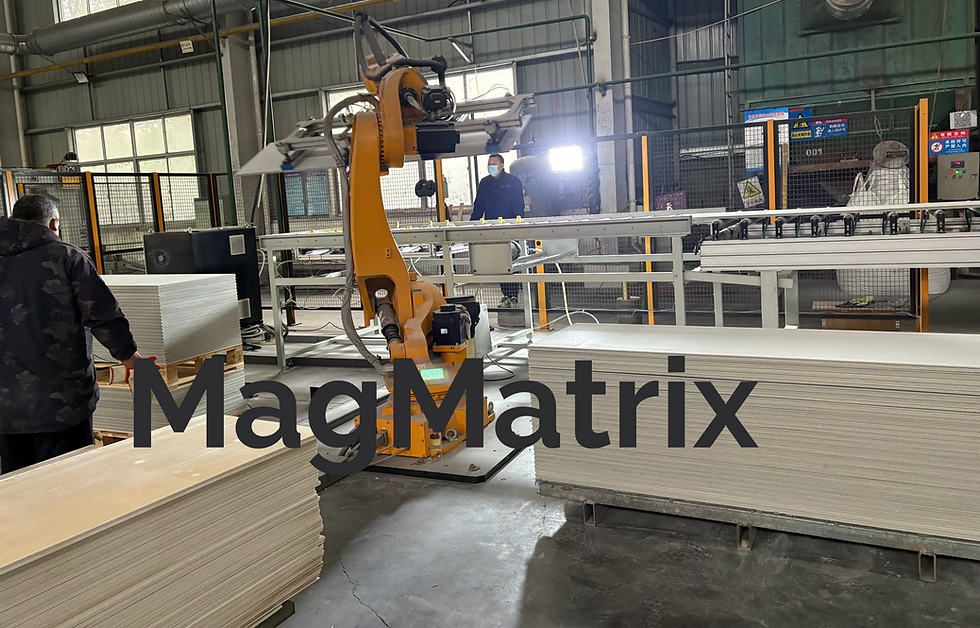
By 2026, automation will streamline production. Advanced facilities can make 1,000 to 3,400 sheets each day. These modern manufacturing lines use automated systems for metering, mixing, conveying, unloading, and stacking to maintain quality.
Energy consumption vs traditional cement boards
Energy efficiency is one of the biggest environmental benefits of magnesium sulfate board production. Making these boards needs 30% less energy than gypsum boards, which usually require temperatures above 150°C for long periods. The cold-press binding process, instead of high-energy kilns, keeps production eco-friendly.
These boards create 18% less CO2 when using natural gas instead of coal. Their carbon footprint is 37.3 kg CO2 eq/m² - 22% lower than Portland cement alternatives. In fact, magnesium oxide-based panels produce about 340 kg of CO2 per metric ton, compared to 740 kg for traditional calcium oxide materials—a 54% reduction.
The boards absorb carbon dioxide while curing. This absorption eliminates about 20-40% of production-related carbon emissions over 15 years.
Recyclability and end-of-life disposal improvements
The 2026 magnesium sulfate board manufacturing has complete recyclability at many stages. Production scraps get reground and reused in manufacturing. This closed-loop system cuts waste and helps the environment.
These boards are great for disposal at the end of their life. You can recycle them fully or let them biodegrade naturally, which reduces landfill waste. The boards break down without harmful substances since magnesium sulfate is an edible mineral used in soil remediation, wastewater treatment, and drinking water purification.
The sawdust from these boards can safely go into landfills without harming land, streams, or water bodies. This is much better than traditional building materials that often cause lasting waste problems.
These manufacturing improvements have made magnesium sulfate boards one of construction's most eco-friendly material options. They meet performance needs while protecting the environment.
Key Performance Features for Modern Construction
Magnesium sulfate boards are becoming invaluable in modern construction projects due to their exceptional performance. These boards provide several advantages that meet the simple requirements of safety, durability, and comfort in buildings.
EN13501-1 A1 fire resistance certification
Magnesium sulfate boards have earned the prestigious A1 fire rating under the EN13501-1 standard - the highest classification for non-combustible materials. This certification shows that these boards never contribute to fire spread. These panels show remarkable resistance and can withstand temperatures above 750°C (1,382°F) for over 30 minutes without any discoloration.
The boards provide fire resistance ratings from 1 to 4 hours, depending on their thickness and how they're used. Standard applications give at least 1 hour of protection, while specialized fire-rated areas get 2 hours or more. The sort of thing I love about these boards is how they release water vapor during fires to help cool and contain flames.
Moisture resistance in high-humidity zones
Magnesium sulfate boards outperform traditional building materials in moisture management. They absorb just 0.34% surface moisture, which is nowhere near the absorption rate of conventional gypsum products. Such minimal absorption stops common issues like warping, swelling, and delamination.
These boards keep their structural integrity in consistently damp environments. Their inorganic makeup creates conditions that don't allow mold, mildew, and fungal growth to thrive. This makes them perfect for bathrooms, kitchens, and other high-humidity areas.
Impact resistance and freeze-thaw durability
High-quality magnesium sulfate boards show impressive mechanical resilience. Premium boards reach impact resistance of 4.5 kilojoules or higher. This is a big deal as it means that they're about five times more impact-resistant than standard drywall. The boards get their strength from fiberglass mesh reinforcement that spreads force throughout the material.
The boards also maintain great dimensional stability through repeated freeze-thaw cycles. Tests reveal they lose just 0.5% mechanical strength after 50 freeze-thaw cycles - well within the 18% allowable threshold. Such exceptional durability makes these boards ideal for challenging environments with extreme temperature changes.
Thermal conductivity and sound insulation properties
The boards deliver excellent thermal insulation with thermal conductivity values as low as 0.186 W/m·K. Lower density versions provide even better insulation while staying structurally sound. Low thermal conductivity helps create energy-efficient buildings by cutting down heat transfer between inside and outside spaces.
Sound performance adds another great benefit. These boards typically achieve sound reduction ratings around 30 dB. This makes them ideal for places that just need noise control, like offices, hospitals, and schools. Together, the thermal and acoustic properties create more comfortable indoor spaces and can help reduce energy costs.
Use Cases in Residential, Commercial, and Modular Projects
Magnesium sulfate boards have become a valuable material in residential construction for interior applications. These boards are a great way to get superior durability and breathability compared to traditional gypsum sheetrock in walls and ceilings. Their high fire resistance will give a safer living space, among other benefits like excellent soundproofing that creates quieter rooms. Homeowners love these boards especially when you have moisture-prone areas like bathrooms, kitchens, and basements, where their resistance to water absorption prevents swelling and warping. The smooth surface readily accepts paint, wallpaper, or decorative finishes that provide both functional and esthetic benefits. The board's inorganic composition prevents mold growth by eliminating food sources for spores, which creates healthier indoor environments.
Commercial buildings now employ magnesium sulfate boards for fire-rated partitions and safety barriers. These boards meet strict fire safety standards and maintain structural integrity under extreme temperatures. Office buildings, hotels, shopping centers, and restaurant's surfaces stay strong and stable, capable of withstanding heavy foot traffic and daily wear. Commercial applications benefit from the board's non-combustible properties, with fire blocking capabilities lasting up to four hours. Schools, hospitals, and other public facilities specify these boards in areas that require improved safety measures and reduced maintenance costs over time.
Magnesium sulfate boards excel as subflooring and tile backers in modular building systems. Their lightweight yet strong nature makes them perfect for prefabricated components, including wall sheathing, ceiling panels, and floor underlayments. Modular bathroom units thrive with these board's exceptional moisture and mold resistance. European manufacturers now incorporate them into Structural Insulated Panels (SIPs) by combining them with EPS or XPS insulation cores. The board's excellent compressive strength supports heavy flooring and furniture while cutting installation time compared to cement or traditional plywood underlayments.
Coastal and high-humidity environments create perfect conditions for magnesium sulfate boards. These sulfate-based boards remain stable and non-reactive when exposed to salt-laden, humid air, unlike traditional MgO boards that use magnesium chloride. Tests at 95% humidity show sulfate boards absorb nowhere near as much moisture as chloride boards, which prevents the "weeping" phenomenon that plagues standard MgO products. This stability proves valuable in coastal regions where metal corrosion presents serious challenges. The board's excellent dimensional stability under temperature fluctuations and humidity changes ensures reliable performance without warping, swelling, or delamination.
Comparison with Other Building Panels in 2026
Builders need to understand the key differences between competing building materials to make informed decisions for specific applications in 2026.
Magnesium oxide vs magnesium sulfate: corrosion and moisture behavior
Traditional magnesium oxide boards with magnesium chloride (MgCl₂) binding agents show 37% higher moisture absorption than magnesium sulfate boards in humid conditions. This moisture creates problems like the "weeping" or "crying" effect where boards pull in environmental moisture and cause surface condensation. The biggest concern lies in MgCl₂-based boards' chloride ions that move through the material and corrode metal fasteners and framing. Magnesium sulfate boards prove safer because they contain no corrosive chlorides and don't react with metal components. Lab tests show MgSO₄ boards' surface moisture absorption is just 0.34%—this is a big deal as it means that it's nine times less than traditional options.
Drywall vs MgSO₄ board: fire and mold resistance
Gypsum-based drywall's vulnerability to moisture damage results in water absorption, swelling, warping, and structural breakdown. Even moisture-resistant gypsum products fail under constant humidity. Fire resistance ratings for gypsum boards range from 30-60 minutes, while magnesium sulfate boards stay structurally sound for up to four hours. Damp environments pose a challenge for gypsum products, especially paper-faced varieties. MgSO₄ boards are completely inorganic and score 0/0/0 on ASTM G21 fungal growth tests, suggesting total mold resistance.
Cement board vs MgSO₄: weight, handling, and cost
Cement boards weigh more than magnesium sulfate alternatives, which creates challenges during transport and installation. The extra weight demands increased structural support. All the same, magnesium sulfate boards deliver similar performance with excellent impact resistance and durability. The initial cost of magnesium sulfate boards runs 15-25% higher than standard gypsum products, but their longer lifespan and lower maintenance needs reduce lifetime costs. The profit margin favors MgSO₄ boards at $116 per cubic meter compared to cement boards' $81.
Conclusion
Magnesium sulfate boards are set to transform construction materials in 2026. These boards offer most important safety advantages with their A1 fire rating that provides 60-90 minutes of protection in emergencies. They also show impressive moisture resistance without the "weeping" issues you'd typically see in traditional MgO products.
These boards give builders plenty of eco-friendly benefits. They use 30% less energy to manufacture than gypsum alternatives and absorb carbon dioxide during the curing process. You can recycle them completely, making them a smart choice for modern construction projects.
The performance of these boards really stands out. They're five times more impact-resistant than standard drywall, which means they last longer in busy areas. Their thermal and acoustic properties create better indoor comfort and help cut down energy costs.
You'll find these boards working perfectly in everything from home bathrooms to commercial fire barriers. They stay dimensionally stable whatever the environmental conditions. Builders working on coastal projects will appreciate the lack of corrosive chlorides, which helps protect metal fasteners.
The original cost might be higher than other options, but magnesium sulfate boards end up saving money over time through reduced maintenance and longer life spans. Construction practices are moving toward eco-friendly, durable options, and these boards are innovative materials that meet all the requirements for modern building projects in 2026.
Comments